
Indian Statistical Institute, ISI MMATH 2021 PMA Solutions & Discussions
ISI MMATH 2021 Multiple Choice Questions PMA, Objectives: Solutions and Discussions
Indian Statistical Institute, ISI, M.Math 2021 PMB Subjective Questions Solutions and Discussions: Click Here
To view ISI MMATH 2020 solutions, hints, and discussions: Click Here
To view ISI MMATH 2018 solutions, hints, and discussions: Click Here
To view ISI MMATH 2017 solutions, hints, and discussions: Click Here
To view ISI MMATH 2016 solutions, hints, and discussions: Click Here
To view previous year’s question papers: Click Here
Problem 1
Suppose  is a continuous function such that
for all  . Then the value of
  is
is
(a)  ;
;
(b)  ;
;
(c)  ;
;
(d)  .
.
Solution:
By continuity,
![\[f(0)=\lim_{x\to 0}\frac{2-\sqrt{x+4}}{\sin 2x}=\lim_{x\to 0}\frac{4-x-4}{\sin 2x (2+\sqrt{x+4})}=\]](https://fractionshub.com/wp-content/ql-cache/quicklatex.com-e45233f809164e5a38681e08827b8698_l3.png "Rendered by QuickLaTeX.com")
![\[=\lim_{x\to 0}\left(-\frac{2x}{\sin 2x}\cdot \frac{1}{2(2+\sqrt{x+4})}\right)=-\frac{1}{2(2+\sqrt{4})}=-\frac{1}{8},\]](https://fractionshub.com/wp-content/ql-cache/quicklatex.com-b9069f08223940ac48323ffcccad7a33_l3.png "Rendered by QuickLaTeX.com")
where the relation  was used.
Answer (a)
Problem 2
A person throws a pair of fair dice. If the sum of the numbers on the dice is a perfect square, then the probability that the number 3 appeared on at least one of the dice is
(a) 
(b) 
(c) 
(d) 
Solution:
The sum of the numbers on the dice takes values from  to
to  The only perfect squares that can appear are
  and
and  The sum appears in
  cases:
![\[(1,3),(2,2),(3,1).\]](https://fractionshub.com/wp-content/ql-cache/quicklatex.com-78e308735072b0f415c27476666c5881_l3.png "Rendered by QuickLaTeX.com")
The sum  appears in cases:
![\[(3,6),(4,5),(5,4),(6,3).\]](https://fractionshub.com/wp-content/ql-cache/quicklatex.com-3a16f7fe7db56e8865f314f166aa3e38_l3.png "Rendered by QuickLaTeX.com")
So, the perfect square appears in  cases. Among them in cases the number appears on one of the dice. The conditional probability of interest is
Answer (b)
Problem 3
Consider the system of linear equations:  . Then
(a) the system is inconsistent
(b) the system has a unique solution
(c) the system has infinitely many solutions
(d) none of the above is true
Solution:
We find that
![\[z=(2x+2y+3z)-2(x+y+z)=4-10=-6.\]](https://fractionshub.com/wp-content/ql-cache/quicklatex.com-e64444b121cf49c6a7ec619bc8710b06_l3.png "Rendered by QuickLaTeX.com")
Then the equations take the form
![\[\begin{cases} x+y=5-z=11 \\ 2x+2y=4-3z=22 \end{cases}\]](https://fractionshub.com/wp-content/ql-cache/quicklatex.com-2fd875ea851a800004404268083c79b4_l3.png "Rendered by QuickLaTeX.com")
These two equations are identical. So, for any  we have a solution
![\[y=11-x, z=-6.\]](https://fractionshub.com/wp-content/ql-cache/quicklatex.com-d1466ba2efd674e89ce9c34e6a891e4f_l3.png "Rendered by QuickLaTeX.com")
Answer (c)
Problem 4
If  then
then  is given by
(a) 
(b) 
(c) 
(d) 
Solution:
We observe that
![\[\frac{d}{dx}(g(x^2))=2xg'(x^2)=2xf(x^2).\]](https://fractionshub.com/wp-content/ql-cache/quicklatex.com-1c0367087be3110a015a0baafd833676_l3.png "Rendered by QuickLaTeX.com")
Hence,
![\[\int x^3 f(x^2)dx=\frac{1}{2}\int x^2 \frac{d}{dx}(g(x^2))dx=\]](https://fractionshub.com/wp-content/ql-cache/quicklatex.com-09922069e24e0fc8ffd6addd835d00bf_l3.png "Rendered by QuickLaTeX.com")
integrate by parts
![\[=\frac{1}{2}x^2 g(x^2)-\frac{1}{2}\int 2x g(x^2)dx+C=\frac{1}{2}x^2 g(x^2)-\int x g(x^2)dx+C\]](https://fractionshub.com/wp-content/ql-cache/quicklatex.com-15a610c1e86a27594014c9e8f1b0e3fc_l3.png "Rendered by QuickLaTeX.com")
Answer (b)
Problem 5
If 
then  is equal to
(a) 
(b) 
(c) 
(d) 
Solution:
For  we have the identity
![\[{}^nC_j+{}^nC_{j+1}=\frac{n!}{j!(n-j)!}+\frac{n!}{(j+1)!(n-j-1)!}=\frac{n!}{j!(n-j-1)!}\left(\frac{1}{n-j}+\frac{1}{j+1}\right)=\]](https://fractionshub.com/wp-content/ql-cache/quicklatex.com-e2948f35fb4ee4268f86ddd96dd2f5a2_l3.png "Rendered by QuickLaTeX.com")
![\[=\frac{(n+1)!}{(j+1)!(n-j)!}={}^{n+1}C_{j+1}.\]](https://fractionshub.com/wp-content/ql-cache/quicklatex.com-f4de200bac43ec8c5576fa8503527eec_l3.png "Rendered by QuickLaTeX.com")
Hence,
![\[\prod^{n-1}_{j=0}\left({}^nC_j+{}^nC_{j+1}\right)=\prod^{n-1}_{j=0}{}^{n+1}C_{j+1}=\frac{((n+1)!)^n}{(\prod^{n-1}_{j=0}(j+1)!)(\prod^{n-1}_{j=0}(n-j)!)}=\frac{((n+1)!)^n}{(\prod^n_{j=1}j!)^2}\]](https://fractionshub.com/wp-content/ql-cache/quicklatex.com-a611c0d70601902b6d521059b7ff22d6_l3.png "Rendered by QuickLaTeX.com")
On the other hand,
![\[\prod^{n-1}_{j=0} {}^nC_j=\frac{(n!)^n}{(\prod^{n-1}_{j=0} j!)(\prod^{n-1}_{j=0} (n-j)!)}=\frac{(n!)^{n+1}}{(\prod^n_{j=1}j!)^2}.\]](https://fractionshub.com/wp-content/ql-cache/quicklatex.com-9da864791ac6b18147ec8ac0326dcdf5_l3.png "Rendered by QuickLaTeX.com")
Hence,
![\[k=\frac{\prod^{n-1}_{j=0}\left({}^nC_j+{}^nC_{j+1}\right)}{\prod^{n-1}_{j=0} {}^nC_j}=\frac{((n+1)!)^n}{(n!)^{n+1}}=\frac{(n+1)^n}{n!}\]](https://fractionshub.com/wp-content/ql-cache/quicklatex.com-319ff0ec9a2c8eae6f59f6ce4ebc44c1_l3.png "Rendered by QuickLaTeX.com")
Answer (a)
Problem 6
Let  be a sequence of functions defined as follows:
![\[f_{n}(x)=x^{n} \cos (2 \pi n x), \quad x \in[-1,1]\]](https://fractionshub.com/wp-content/ql-cache/quicklatex.com-4f6e911245b6b74504d6ebc0bc852709_l3.png "Rendered by QuickLaTeX.com")
Then  exists if and only if belongs to the interval
(a) 
(b) 
(c) ![[0,1]](https://fractionshub.com/wp-content/ql-cache/quicklatex.com-e4206fd46f63fb93a794d3d340fa3b28_l3.png "Rendered by QuickLaTeX.com")
(d) ![(-1,1]](https://fractionshub.com/wp-content/ql-cache/quicklatex.com-27a9d49724c6a4507e2d1aab09a54822_l3.png "Rendered by QuickLaTeX.com")
Solution:
If  then
then
![\[|f_n(x)|\leq |x|^n\to 0, \ n\to\infty;\]](https://fractionshub.com/wp-content/ql-cache/quicklatex.com-904e42dcab75e1db69c0f86b54fc74a3_l3.png "Rendered by QuickLaTeX.com")
If  then
then
![\[f_n(x)=\cos(2\pi n)=1\to 1, \ n\to\infty;\]](https://fractionshub.com/wp-content/ql-cache/quicklatex.com-9a29bf9dd63c1c9458c3984f70d4d4d8_l3.png "Rendered by QuickLaTeX.com")
If  then
then
![\[f_n(x)=(-1)^n\cos(-2\pi n)=(-1)^n,\]](https://fractionshub.com/wp-content/ql-cache/quicklatex.com-c16fd1a0f3a4fde851e4bf8f72eda57e_l3.png "Rendered by QuickLaTeX.com")
and this does not converge. The limit of  exists if and only if
Answer (d)
Problem 7
Let  be a set of
  elements. The number of ways in which distinct non-empty subsets
  of can be chosen such that
 , is
, is
(a) 
(b) 
(c) 
(d) 
Solution:
Denote  Each difference
 contains at least one element. Denote this element by
  If
If  then
then  so
so  All elements
  are distinct. Hence,
  is an ordering of the set . There are
  ways to order elements of the set
  and every ordering defines a sequence of non-empty distinct subsets by the rule

Answer (c)
Problem 8
Let  be a
be a  matrix such that both and
  are non-null.
If  , then the rank of is
(a) ;
(b) ;
(c) ;
(d) .
Solution:
Elements of the adjugate matrix  are equal (up to signs) to cofactors of elements of the matrix (i.e.
  minors of ). Since
  the rank of is
  Since
Since  there exists at least one non-zero minor of and the rank of is
  We deduce that the rank of is equal to .
Answer (c)
Problem 9
The set of all  satisfying the inequality
![\[\frac{1}{\sqrt{a}} \int_{1}^{a}\left(\frac{3}{2} \sqrt{x}+1-\frac{1}{\sqrt{x}}\right) d x<4\]](https://fractionshub.com/wp-content/ql-cache/quicklatex.com-915218af7d779fa9e9f3c7bb7563d677_l3.png "Rendered by QuickLaTeX.com")
is equal to the interval
(a) 
(b) 
(c) 
(d) 
Solution:
At first we observe that  Evaluate the integral:
![\[\int^a_1 \left(\frac{3}{2}\sqrt{x}+1-\frac{1}{\sqrt{x}}\right)dx=\left(x^{3/2}+x-2\sqrt{x}\right)\bigg|^a_1=a^{3/2}+a-2\sqrt{a}.\]](https://fractionshub.com/wp-content/ql-cache/quicklatex.com-79edd861feb9da534ae6ffac7f3eb3ec_l3.png "Rendered by QuickLaTeX.com")
The inequality transforms to
![\[\frac{a^{3/2}+a-2\sqrt{a}}{\sqrt{a}}<4;\]](https://fractionshub.com/wp-content/ql-cache/quicklatex.com-136b2f5127094376e4c1b709a616a597_l3.png "Rendered by QuickLaTeX.com")
![\[a+\sqrt{a}-6<0;\]](https://fractionshub.com/wp-content/ql-cache/quicklatex.com-f53b22f050daf4bb08bcea056a841c75_l3.png "Rendered by QuickLaTeX.com")
![\[(\sqrt{a}+3)(\sqrt{a}-2)<0;\]](https://fractionshub.com/wp-content/ql-cache/quicklatex.com-d21929fcc9e9153cc6dbede0c5e71d30_l3.png "Rendered by QuickLaTeX.com")
![\[\sqrt{a}<2; \ 0<a<4.\]](https://fractionshub.com/wp-content/ql-cache/quicklatex.com-f61bed6feaa6aa9c59f04c416b696ae4_l3.png "Rendered by QuickLaTeX.com")
Answer (d)
Problem 10
Let  be the set of all continuous functions
 ![f:[0,1] \rightarrow \mathbb{R}](https://fractionshub.com/wp-content/ql-cache/quicklatex.com-db8b07c23a13d0d0047f225fd9fc6037_l3.png "Rendered by QuickLaTeX.com") and
and  be the set of all differentiable functions
 ![g:[0,1] \rightarrow \mathbb{R}](https://fractionshub.com/wp-content/ql-cache/quicklatex.com-8202efe1c1faafa30b854611bb5df72f_l3.png "Rendered by QuickLaTeX.com") such that the derivative
such that the derivative  is continuous. (Here, differentiability at 0 means right differentiability and differentiability at 1 means left differentiability.) If
  is defined by
  , then
(a)  is one-to-one and onto
(b) is one-to-one but not onto
(c) is onto but not one-to-one
(d) is neither one-to-one nor onto.
Solution:
Consider a constant function  Then
Then  Since
Since  are distinct for different , the mapping is not one-to-one.
Given a continuous functions  consider
![\[g(x)=\int^x_0 f(t)dt.\]](https://fractionshub.com/wp-content/ql-cache/quicklatex.com-66721aecd4183ca9d6ce367628bf18d5_l3.png "Rendered by QuickLaTeX.com")
By the Fundamental Theorem of Calculus,  and
and  The mapping is onto.
Answer (c)
Problem 11
Suppose  are in A.P. and
  are in G.P. If
  and
and 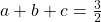 , then the value of is
(a) 
(b) 
(c) 
(d) 
Solution:
Let  be the difference of the arithmetic progression. Then
 and we find
![\[a+b+c=3b=\frac{3}{2}, \ b=\frac{1}{2}.\]](https://fractionshub.com/wp-content/ql-cache/quicklatex.com-bc50d64828d82a3dc8460c1b8adc0dca_l3.png "Rendered by QuickLaTeX.com")
Further,
![\[\frac{b^2}{a^2}=\frac{c^2}{b^2},\]](https://fractionshub.com/wp-content/ql-cache/quicklatex.com-1b33a91baef2d7659b66008007afb915_l3.png "Rendered by QuickLaTeX.com")
and
![\[b^4=a^2c^2=(b-d)^2(b+d)^2=(b^2-d^2)^2.\]](https://fractionshub.com/wp-content/ql-cache/quicklatex.com-717ce12344b6eb110900a6ecd1e24fd8_l3.png "Rendered by QuickLaTeX.com")
Taking square roots we find
![\[b^2=|b^2-d^2|,\]](https://fractionshub.com/wp-content/ql-cache/quicklatex.com-19bac9bdedcc3e2bc5df7a358f3f930d_l3.png "Rendered by QuickLaTeX.com")
i.e. either  or
or  The case
  is impossible, as
  Also, the condition implies that
  and
and  Correspondingly,
Answer (d)
Problem 12
The number of distinct even divisors of
![\[\prod_{k=1}^{5} k !\]](https://fractionshub.com/wp-content/ql-cache/quicklatex.com-ce4d9bddbf6f046d9bc826781dd9fc31_l3.png "Rendered by QuickLaTeX.com")
is

(a)  ;
;
(b)  ;
;
(c)  ;
;
(d)  .
.
Solution:
We have
![\[\prod^5_{k=1} k!=2!3!4!5!=2\cdot (2\cdot 3) \cdot (2\cdot 3\cdot 4)\cdot (2\cdot 3\cdot 4\cdot 5)=2^8 3^35.\]](https://fractionshub.com/wp-content/ql-cache/quicklatex.com-b0a76a0c1e08ac2dbf771c346d256200_l3.png "Rendered by QuickLaTeX.com")
Every even divisor of  is of the type
  with
with 

 There are
  even divisors.
Answer (c)
Problem 13
Let  be the triangular region in the
  -plane with vertices at
  and
and  . Then the value of
![\[\iint_{D} \frac{2}{1+x^{2}} d x d y\]](https://fractionshub.com/wp-content/ql-cache/quicklatex.com-8d37d91f5e8066fecca597e5538c560b_l3.png "Rendered by QuickLaTeX.com")
is
(a) 
(b) 
(c)  ;
;
(d) 
Solution:
The region is defined by inequalities  Hence
Hence
![\[\iint_D \frac{2}{1+x^2}dxdy=\int^1_0 \frac{2}{1+x^2}\int^1_x dydy=\int^1_0 \frac{2(1-x)}{1+x^2}dx=\]](https://fractionshub.com/wp-content/ql-cache/quicklatex.com-404ba96123f3d8ddb1f815b949bf4628_l3.png "Rendered by QuickLaTeX.com")
![\[=2\int^1_0 \frac{1}{1+x^2}dx-\int^1_0 \frac{2x}{1+x^2}dx=\left(2\arctan(x) -\ln (1+x^2)\right)\bigg|^1_0=\frac{\pi}{2}-\ln(2).\]](https://fractionshub.com/wp-content/ql-cache/quicklatex.com-835187d2e840046fddf6f1edea786d49_l3.png "Rendered by QuickLaTeX.com")
Answer (b)
Problem 14
Given a real number  , define a sequence
  by the following recurrence relation:
![\[x_{n+1}=\alpha x_{n}+(1-\alpha) x_{n-1}, \quad n \geq 1\]](https://fractionshub.com/wp-content/ql-cache/quicklatex.com-fbfe4763713712b17b4073266a737e95_l3.png "Rendered by QuickLaTeX.com")
If  then the value of
  is
is
(a) 
(b) 
(c) 
(d) 
Solution:
Consider the characteristic equation of the recurrence:
![\[k^2-\alpha k -(1-\alpha)=0.\]](https://fractionshub.com/wp-content/ql-cache/quicklatex.com-1cd3d874e03266a4d4a74dc6804fca22_l3.png "Rendered by QuickLaTeX.com")
Roots are  and
and  Hence,
![\[x_n=A+B(\alpha-1)^n.\]](https://fractionshub.com/wp-content/ql-cache/quicklatex.com-867785c5015a103d5d0d2a1ae9ef34be_l3.png "Rendered by QuickLaTeX.com")
Since  we find that
  To find we use first two values:
![\[\begin{cases} A+B=x_0 \\ A+B(\alpha-1)=x_1 \end{cases}\]](https://fractionshub.com/wp-content/ql-cache/quicklatex.com-81465c3f64a855424cfbc665029a6f2d_l3.png "Rendered by QuickLaTeX.com")
Then  So,
So,
![\[l=A=\frac{(1-\alpha)x_0+x_1}{2-\alpha}.\]](https://fractionshub.com/wp-content/ql-cache/quicklatex.com-5546278d5e2c20ac6cfc4cc768f495dc_l3.png "Rendered by QuickLaTeX.com")
Answer (b)
Problem 15
A straight line passes through the intersection of the lines given by  and
and  and makes equal intercepts of the same sign on the coordinate axes. The equation of the straight line is
(a) 
(b) 
(c) 
(d) 
Solution:
We find the intersection of the lines:
![\[\begin{cases} 3x-4y=-1 \\ 5x+y=1 \end{cases} \Rightarrow x=\frac{3}{23}, y=\frac{8}{23}.\]](https://fractionshub.com/wp-content/ql-cache/quicklatex.com-103bbe81725d115b6f9623cf2b2ddf9c_l3.png "Rendered by QuickLaTeX.com")
The line we are looking for passes through the point  and makes equal (positive) intercepts with the coordinate axes. The slope of such line is
  and its equation is of the form
![\[x+y=b.\]](https://fractionshub.com/wp-content/ql-cache/quicklatex.com-01c3360105357db3e6928799dc20b685_l3.png "Rendered by QuickLaTeX.com")
We find 
![\[\frac{3}{23}+\frac{8}{23}=b, \ \ b=\frac{11}{23}.\]](https://fractionshub.com/wp-content/ql-cache/quicklatex.com-6fc4de4840c21a5e576850da9add95c2_l3.png "Rendered by QuickLaTeX.com")
So, the equation of the line is
![\[x+y=\frac{11}{23}.\]](https://fractionshub.com/wp-content/ql-cache/quicklatex.com-9a59f785a41fcd7f0efc5b0df84b86b0_l3.png "Rendered by QuickLaTeX.com")
Equivalently,
![\[23x+23y-11=0.\]](https://fractionshub.com/wp-content/ql-cache/quicklatex.com-7eb0eeca03f93e8a358b65f152d4cd7e_l3.png "Rendered by QuickLaTeX.com")
Answer (d)
Problem 16
The series
![\[\sum_{n} \frac{3 \cdot 6 \cdot 9 \cdots 3 n}{7 \cdot 10 \cdot 13 \cdots(3 n+4)} x^{n}, \quad x>0\]](https://fractionshub.com/wp-content/ql-cache/quicklatex.com-3f77685d164955d93c1e2d0b57a28241_l3.png "Rendered by QuickLaTeX.com")
(a) converges for  and diverges for
(b) converges for all 
(c) converges for  and diverges for
(d) converges for  and diverges for
  .
.
Solution:
Denote  Apply the ratio test:
![\[\frac{c_n}{c_{n+1}}=\frac{3(n+1)+4}{3(n+1)}\to 1, \ n\to\infty.\]](https://fractionshub.com/wp-content/ql-cache/quicklatex.com-315921306eb547bf08fee31a5fc2e237_l3.png "Rendered by QuickLaTeX.com")
Hence, the radius of convergence of the power series is equal to 1. The series is convergent for and is divergent for 
We study convergence at  Observe that
![\[n\frac{c_n}{c_{n+1}}-(n+1)\to \frac{1}{3}, \ n\to\infty.\]](https://fractionshub.com/wp-content/ql-cache/quicklatex.com-6c023bdfadfc95396728895cf0128291_l3.png "Rendered by QuickLaTeX.com")
Hence, there exists  such that for all
  we have
![\[n\frac{c_n}{c_{n+1}}-(n+1)>\frac{1}{4}.\]](https://fractionshub.com/wp-content/ql-cache/quicklatex.com-932dd9c04faf9b63e78c3f0120d9c46b_l3.png "Rendered by QuickLaTeX.com")
Equivalently,
![\[nc_n-(n+1)c_{n+1}>\frac{1}{4}c_{n+1}.\]](https://fractionshub.com/wp-content/ql-cache/quicklatex.com-ee5da9967ac4233b61483f5e14c8c321_l3.png "Rendered by QuickLaTeX.com")
Taking the sum from  to
to  we find
![\[Nc_N-(N+p)c_{N+p}>\frac{1}{4}\sum^{N+p}_{n=N+1}c_n.\]](https://fractionshub.com/wp-content/ql-cache/quicklatex.com-4cafc4093274d7311f6e17983bb62f5c_l3.png "Rendered by QuickLaTeX.com")
So,
![\[\sum^{N+p}_{n=N+1}c_n<4Nc_N.\]](https://fractionshub.com/wp-content/ql-cache/quicklatex.com-9d942e4774df556b03d7b319678d231d_l3.png "Rendered by QuickLaTeX.com")
The sequence of partial sums  is bounded and the series is convergent.
Answer (a)
Problem 17
Suppose and  are two square matrices such that the largest eigenvalue of
  is positive. Then the smallest eigen value of
(a) must be positive
(b) must be negative
(c) must be
(d) is none of the above
Solution:
We compute the trace of the matrix:
![\[tr(AB-BA)=tr(AB)-tr(BA)=tr(AB)-tr(AB)=0.\]](https://fractionshub.com/wp-content/ql-cache/quicklatex.com-217bd29c6e1182f38a88c93a55a92791_l3.png "Rendered by QuickLaTeX.com")
Since the trace is the sum of eigenvalues and the largest eigenvalue of  is positive, the smallest eigenvalue of is negative.
Answer (b)
Problem 18
The number of saddle points of the function  is
is
(a) ;
(b) ;
(c) ;
(d) none of the above.
Solution:
To find stationary points we compute the gradient of 
![\[\nabla f= (8x^3-2x \ \ 6y).\]](https://fractionshub.com/wp-content/ql-cache/quicklatex.com-86725e5a51513f2e29a3acf5406eef0c_l3.png "Rendered by QuickLaTeX.com")
Stationary point  is found from the system
![\[\begin{cases} 8x^3-2x=0 \\ 6y=0 \end{cases}\]](https://fractionshub.com/wp-content/ql-cache/quicklatex.com-94966a5732339a83d282073618bb5869_l3.png "Rendered by QuickLaTeX.com")
There are three stationary points: 

 The matrix of second derivatives of
  is
is
![\[\begin{pmatrix} 24x^2-2 & 0 \\ 0 & 6 \end{pmatrix}\]](https://fractionshub.com/wp-content/ql-cache/quicklatex.com-43f2e01d5339888e6de27f673674bb17_l3.png "Rendered by QuickLaTeX.com")
Eigenvalues are  and
and  The stationary point is a saddle point if the first eigenvalue is negative. It happens only for the point
Answer (a)
Problem 19
Suppose  is a cyclic group and
  . There does not exist any
  such that
  Also, there does not exist an
  such that
  . Then,
(a) there exists an element  such that
  .
.
(b) there exists an element such that  .
.
(c) the smallest exponent  such that
  for some is
(d) none of the above is true.
Solution:
Let be the generator of  Then
Then  for some integer
  Observe that is odd. Similarly,
  for some odd
  . But then
  where
where  is even. Define
  Then
Then 
Answer (a)
Problem 20
The number of real roots of the polynomial  is
is
(a) ;
(b) ;
(c) ;
(d) .
Solution:
Denote  The derivative of is
![\[f'(x)=3x^2-2.\]](https://fractionshub.com/wp-content/ql-cache/quicklatex.com-a1a312e41e13b98967e2650bdf554fc9_l3.png "Rendered by QuickLaTeX.com")
 The function is increasing on
 ![(-\infty,-\sqrt{\frac{2}{3}}],](https://fractionshub.com/wp-content/ql-cache/quicklatex.com-b086a0016dcfec1345525a983ef1f474_l3.png "Rendered by QuickLaTeX.com") decreasing on
decreasing on ![[-\sqrt{\frac{2}{3}},\sqrt{\frac{2}{3}}]](https://fractionshub.com/wp-content/ql-cache/quicklatex.com-f7bbf564bba15caf09dc6a034150f101_l3.png "Rendered by QuickLaTeX.com") , increasing on
, increasing on 
![\[f(\sqrt{\frac{2}{3}})=\frac{2}{3}\sqrt{\frac{2}{3}}-2\sqrt{\frac{2}{3}}+7=7-\frac{4}{3}\sqrt{\frac{2}{3}}>0.\]](https://fractionshub.com/wp-content/ql-cache/quicklatex.com-1c99cf59693d8f3f6b80bce77ab1c9d6_l3.png "Rendered by QuickLaTeX.com")
The only real zero of is located in 
Answer (b)
Problem 21
Suppose that a  matrix has an eigen value . If the matrix
 is equal to
![\[\left[\begin{array}{ccc} 1 & 0 & -2 \\ 0 & 0 & 0 \\ 0 & 0 & 0 \end{array}\right]\]](https://fractionshub.com/wp-content/ql-cache/quicklatex.com-b58273a1cb62334378b57067934398f2_l3.png "Rendered by QuickLaTeX.com")
then the eigen vectors of corresponding to the eigenvalue are in
the form,
(a) ![\left[\begin{array}{c} 2 t \\ 0 \\ t \end{array}\right], t \in \mathbb{R}](https://fractionshub.com/wp-content/ql-cache/quicklatex.com-fa35fdb398cd58d2dcd841c8eb37c6a4_l3.png "Rendered by QuickLaTeX.com") ;
;
(b) ![\left[\begin{array}{c} 2 t \\ s \\ t \end{array}\right], s, t \in \mathbb{R}](https://fractionshub.com/wp-content/ql-cache/quicklatex.com-ef5a18254d158a6c4884aee7560bf34b_l3.png "Rendered by QuickLaTeX.com") ;
;
(c) ![\left[\begin{array}{c} t \\ 0 \\ -2 t \end{array}\right], t \in \mathbb{R}](https://fractionshub.com/wp-content/ql-cache/quicklatex.com-2192aec3459b2424c1704a9e4ffc5898_l3.png "Rendered by QuickLaTeX.com") ;
;
(d) ![\left[\begin{array}{c} t \\ s \\ 2 t \end{array}\right], s, t \in \mathbb{R}](https://fractionshub.com/wp-content/ql-cache/quicklatex.com-4f3ad1babc4766a0d8139cca6926b9fb_l3.png "Rendered by QuickLaTeX.com")
Solution:
Let  be the eigenvector of corresponding to the eigenvalue
 Then
Then
 Denote
![\[(A+I)v=\begin{bmatrix} x-2z \\ 0 \\ 0 \end{bmatrix}=0.\]](https://fractionshub.com/wp-content/ql-cache/quicklatex.com-3b9737f1f125eadce703837b96f5d06f_l3.png "Rendered by QuickLaTeX.com")
So,  Let
Let 
 The vector is of the form
![\[v=\begin{bmatrix} 2t \\ s \\ t \end{bmatrix}\]](https://fractionshub.com/wp-content/ql-cache/quicklatex.com-35529b9715c59b840291be2ac81b937c_l3.png "Rendered by QuickLaTeX.com")
Answer (b)
Problem 22
Consider the function  defined by
  . For
. For  and
and  , the value of the limit
![\[\lim _{t \rightarrow 0} \frac{f(\vec{u}+t \vec{v})-f(\vec{u})}{t}\]](https://fractionshub.com/wp-content/ql-cache/quicklatex.com-309b60d1a2988ab919bd9512244e2259_l3.png "Rendered by QuickLaTeX.com")
is
(a) 
(b) 
(c) 
(d) none of the above
Solution:
The gradient of equals
![\[\nabla f= [2x(y-1) \ \ \ x^2].\]](https://fractionshub.com/wp-content/ql-cache/quicklatex.com-614b3aa684116201fc5a915388a8af36_l3.png "Rendered by QuickLaTeX.com")
Hence
![\[\lim_{t\to 0}\frac{f(\vec{u}+t\vec{v})-f(\vec{u})}{t}=\nabla f(\vec{u}) \vec{v}=\begin{bmatrix} -\frac{1}{2} & \frac{1}{4} \end{bmatrix}\begin{bmatrix} 3 \\ 4 \end{bmatrix}=-\frac{1}{2}.\]](https://fractionshub.com/wp-content/ql-cache/quicklatex.com-0732ffb310991c163f42270daf38f8bd_l3.png "Rendered by QuickLaTeX.com")
Answer (c)
Problem 23
Suppose  is a solution of the differential equation
  such that
  and
and  . Then
(a)  as
as 
(b)  as
as
(c) as 
(d) as
Solution:
The characteristic equation is  Its roots are
  and
and  The solution is of the form
![\[\phi(x)=Ae^{2x}+Be^{-x}.\]](https://fractionshub.com/wp-content/ql-cache/quicklatex.com-619d15aaee07a984b3519a2fd367a4ef_l3.png "Rendered by QuickLaTeX.com")
To find and we use initial conditions:
![\[\begin{cases} \phi(0)=A+B=1 \\ \phi'(0)=2A-B=5 \end{cases}\]](https://fractionshub.com/wp-content/ql-cache/quicklatex.com-a299d1e8b73db471aeaa0f1367e8799b_l3.png "Rendered by QuickLaTeX.com")
Hence,  and the solution is
  In particular,
  as
as 
Answer (c)
Problem 24
A fair die is rolled five times. What is the probability that the largest
number rolled is  ?
?
(a) 
(b) 
(c) 
(d) 
Solution:
Denote by  the event that all numbers rolled are
 Then
Then  The event of interest is
  Its probability is
![\[\left(\frac{5}{6}\right)^5-\left(\frac{4}{6}\right)^5=\left(\frac{5}{6}\right)^5-\left(\frac{2}{3}\right)^5\]](https://fractionshub.com/wp-content/ql-cache/quicklatex.com-845f767e13824ff6c5874e9db9a9eda7_l3.png "Rendered by QuickLaTeX.com")
Answer (d)
Problem 25
Two rows of chairs, facing each other, are laid out. The number of different ways that couples can sit on these chairs such that each person sits directly opposite to his/her partner is
(a)
(b) 
(c) 
(d) 
Solution:
There are choices how each couple can choose its pair of opposite chairs. When a pair of chairs is chosen, there are ways for each couple they can sit on these chairs, i.e.  choices for all couples. Totally there are
  ways the couples can sit on the chairs.
Answer (c)
Problem 26
Consider the function  defined on the complex plane
  by
by  . For a real number
  , let
, let  and
and  . Then
(a) both and are straight line segments
(b) is a circle and is a straight line segment
(c) is a straight line segment and is a circle
(d) both and are circles
Solution:
Let  Then
Then 
 and the set consists of points of the form
![\[e^{c+iy}=e^c(\cos y +i\sin y), \ y\in\mathbb{R}.\]](https://fractionshub.com/wp-content/ql-cache/quicklatex.com-c37eb680db122742c17c75500de8aa49_l3.png "Rendered by QuickLaTeX.com")
is a cricle of center nd radius 
Let  Then
Then 
 and the set consists of point of the form
![\[e^{x+ic}=e^x e^{ic}, \ x\in\mathbb{R}.\]](https://fractionshub.com/wp-content/ql-cache/quicklatex.com-02ac231f4949876f4ff5d46cd12c7756_l3.png "Rendered by QuickLaTeX.com")
is a straight line connecting and 
Answer (b)
Problem 27
Consider two real valued functions and  given by
 for , and
  for
for 
Which of the following statements about inverse functions is true?
(a) Neither  nor
nor  exists
(b) exists, but not
(c) does not exist, but does
(d) Both and exist.
Solution:
The function  is strictly decreasing:
![\[\lim_{x\to 1+}f(x)=+\infty, \ \ \lim_{x\to \infty}f(x)=1.\]](https://fractionshub.com/wp-content/ql-cache/quicklatex.com-de4d5be55d04937987704093b91412dc_l3.png "Rendered by QuickLaTeX.com")
So, is a bijection of the set  exists.
The function  is strictly decreasing:
![\[\lim_{x\to \infty}g(x)=-\infty, \ \ \lim_{x\to -\infty}g(x)=\infty.\]](https://fractionshub.com/wp-content/ql-cache/quicklatex.com-b910674265fa9746691811a9ddc2c2f2_l3.png "Rendered by QuickLaTeX.com")
So, is a bijection of  exists.
Answer (d)
Problem 28
A circle is drawn with centre at touching  externally. Then the circle touches
(a) both the axes
(b) only the -axis
(c) none of the two axes
(d) only the  -axis
-axis
Solution:
Let  be the radius of the circle centered at
  The equation of the second circle is
![\[(x-2)^2+(y+3)^2=16.\]](https://fractionshub.com/wp-content/ql-cache/quicklatex.com-531a21cb4907f059c27995b674962b4a_l3.png "Rendered by QuickLaTeX.com")
It is centered at  and of radius
  The distance between centers of circles is
![\[\sqrt{(2+1)^2+(-3-1)^2}=5.\]](https://fractionshub.com/wp-content/ql-cache/quicklatex.com-af548790c183788d156b12197f463c0e_l3.png "Rendered by QuickLaTeX.com")
Hence,  and the first circle touches both axes (as
  and
and  belong to the first circle).
Answer (a)
Problem 29
Let  for all
  and
and  . Then the value of
  is
is
(a) 
(b) 
(c) 
(d) 
Solution:
Observe that  By assumption,
![\[f(x)=f(x-y)f(y).\]](https://fractionshub.com/wp-content/ql-cache/quicklatex.com-cd78e79567aefbefa088add8fd389566_l3.png "Rendered by QuickLaTeX.com")
Differentiate this equation in 
![\[f'(x)=f'(x-y)f(y).\]](https://fractionshub.com/wp-content/ql-cache/quicklatex.com-145857873b7b6b1d567d82d50372b0ae_l3.png "Rendered by QuickLaTeX.com")
Differentiate in :
![\[0=-f'(x-y)f(y)+f(x-y)f'(y), \ f'(x-y)f(y)=f(x-y)f'(y).\]](https://fractionshub.com/wp-content/ql-cache/quicklatex.com-caf5031b79a96486323e4b12359cbce2_l3.png "Rendered by QuickLaTeX.com")
Then
![\[f(y)=\frac{f(0)f'(y)}{f'(0)}=\frac{f'(y)}{p}.\]](https://fractionshub.com/wp-content/ql-cache/quicklatex.com-7432f92c44e011a6ff2b6b4a86f02736_l3.png "Rendered by QuickLaTeX.com")
Take 

![\[p=f'(0)=f'(-5)f(5)=\frac{f'(-5)f'(5)}{p}=\frac{q}{p}f'(-5), \ f'(-5)=\frac{p^2}{q}.\]](https://fractionshub.com/wp-content/ql-cache/quicklatex.com-4e0902382c7720f2aa8df5207f5cac26_l3.png "Rendered by QuickLaTeX.com")
Answer (d)
Problem 30
Let
![\[A=\left[\begin{array}{lll} a & 1 & 1 \\ b & a & 1 \\ 1 & 1 & 1 \end{array}\right]\]](https://fractionshub.com/wp-content/ql-cache/quicklatex.com-104d05a4cb925ff5444f5f455ab3a74a_l3.png "Rendered by QuickLaTeX.com")
The number of elements in the set
![\[\left\{(a, b) \in \mathbb{Z}^{2}: 0 \leq a, b \leq 2021, \operatorname{rank}(A)=2\right\}\]](https://fractionshub.com/wp-content/ql-cache/quicklatex.com-77cc6fc44b6e8c3d936c878783ee4620_l3.png "Rendered by QuickLaTeX.com")
is
(a) 
(b) 
(c) 
(d) 
Solution:
The determinant of must be zero:
![\[\det(A)=a^2+1+b-a-b-a=(a-1)^2.\]](https://fractionshub.com/wp-content/ql-cache/quicklatex.com-c5d6db638bbcb6a496221ad855e41a2a_l3.png "Rendered by QuickLaTeX.com")
Hence,  and the matrix is of the form
![\[A=\begin{bmatrix} 1 & 1 & 1 \\ b & 1 & 1 \\ 1 & 1 & 1 \end{bmatrix}.\]](https://fractionshub.com/wp-content/ql-cache/quicklatex.com-03c8ddbaf819a99b1242653def40ad9d_l3.png "Rendered by QuickLaTeX.com")
The rank of is if and only if  So, there are
  possible values for
Answer (a)
Sir, what will be the expected cutoff for mmath 2021?
Except cut off to go around 60 to 70 for PMA and 4 Questions for PMB.
Sir i got 77 marks in PMA and i solved 2 questions completely in PMB and just attempted another 3 questions in PMB.is there any possibility for getting inteview call
Are you selected for interview?