
ISI MMath Solutions and Discussion 2019 : PMB
ISI MMath PMB 2019 Subjective Questions along with hints and solutions and discussions
To view ISI MMATH 2020 solutions, hints, and discussions: Click Here
To view ISI MMATH 2018 solutions, hints, and discussions: Click Here
To view ISI MMATH 2017 solutions, hints, and discussions: Click Here
To view ISI MMATH 2016 solutions, hints, and discussions: Click Here
To view previous year’s question papers: Click Here
Problem 1.
Let  be a continuous function satisfying
![\[\lim_{x\to \infty}f(x)=\lim_{x\to -\infty}f(x)=0.\]](https://fractionshub.com/wp-content/ql-cache/quicklatex.com-37f4b212d117f115dbafc36ea563dfdf_l3.png "Rendered by QuickLaTeX.com")
Show that  is a bounded function on
  and attains a maximum or a minimum. Give an example to show that it attains a maximum but not a minimum.
Topic: Real Analysis
Difficulty level: Medium
Indian Statistical Institute, ISI MMath 2019 Problem 1 Hints along with Solution & Discussion
Hint 1
Assume that is non-negative, i.e.  for all
  If
If  for all
  then obviously is bounded and attains its maximal (and minimal) value at each point. Let
  for some
  By assumption, there exists
  such that for all
  and all
 Let
Let  be the restriction of to
 ![[-C,C].](https://fractionshub.com/wp-content/ql-cache/quicklatex.com-6470348d1ee76a25275242bc62f7f73c_l3.png "Rendered by QuickLaTeX.com")
![g:[-C,C]\to \mathbb{R}](https://fractionshub.com/wp-content/ql-cache/quicklatex.com-27c48f8fafc330d5e875b85e0ec34383_l3.png "Rendered by QuickLaTeX.com") is a continuous function on a compact segment.
is a continuous function on a compact segment.
Hint 2
Let be a continuous function satisfying
The function  is a non-negative continuous function satisfying
![\[\lim_{x\to \infty}h(x)=\lim_{x\to -\infty}h(x)=0.\]](https://fractionshub.com/wp-content/ql-cache/quicklatex.com-baa8cd60228d3e8c2e0e16c15325a132_l3.png "Rendered by QuickLaTeX.com")
Hint 3
For the Example part, consider the function 
Full Solution
Step 1:
Assume that is non-negative, i.e. for all If for all then obviously is bounded and attains its maximal (and minimal) value at each point. Let for some By assumption, there exists such that for all and all Let be the restriction of to is a continuous function on a compact segment. Hence,  is bounded and attains its maximal value on
 ![[-C,C],](https://fractionshub.com/wp-content/ql-cache/quicklatex.com-1ff1b0d9a81a719919d98ee67407a88d_l3.png "Rendered by QuickLaTeX.com") i.e. there exists
i.e. there exists ![x_1\in [-C,C],](https://fractionshub.com/wp-content/ql-cache/quicklatex.com-8cf7ee3ea442110a1732528b0cfa7513_l3.png "Rendered by QuickLaTeX.com") such that
such that ![g(x_1)=\max_{x\in [-C,C]}g(x).](https://fractionshub.com/wp-content/ql-cache/quicklatex.com-9bc320ff8a39a2a3bd38bc1e482194f8_l3.png "Rendered by QuickLaTeX.com") We check that the function attains its maximal value at
We check that the function attains its maximal value at  Let
Let ![x\in [-C,C].](https://fractionshub.com/wp-content/ql-cache/quicklatex.com-96938494e5fe38bbea06b49e8e914384_l3.png "Rendered by QuickLaTeX.com") Then
Then
![\[f(x)=g(x)\leq g(x_1)=f(x_1).\]](https://fractionshub.com/wp-content/ql-cache/quicklatex.com-3e2e1a017bb1b8c6d50d1410757efb3c_l3.png "Rendered by QuickLaTeX.com")
Let or  Then
Then ![x_0\in [-C,C]](https://fractionshub.com/wp-content/ql-cache/quicklatex.com-145640fad2d2a095148a2694611684a9_l3.png "Rendered by QuickLaTeX.com") and
and
![\[f(x)<f(x_0)=g(x_0)\leq g(x_1)=f(x_1).\]](https://fractionshub.com/wp-content/ql-cache/quicklatex.com-cea3eed4f514e0af5c4a813b6eb0ec7d_l3.png "Rendered by QuickLaTeX.com")
So, for each 
![\[0\leq f(x)\leq f(x_1).\]](https://fractionshub.com/wp-content/ql-cache/quicklatex.com-41a6eb7e33d9850ada577ae8249f1451_l3.png "Rendered by QuickLaTeX.com")
is bounded and attains its maximal value.
Step 2:
Let be a continuous function satisfying
The function is a non-negative continuous function satisfying
By step 1,  is bounded and attains its maximal value. It means that there exists
  such that for all
![\[0\leq h(x)=|f(x)|\leq h(x_1)=|f(x_1)|.\]](https://fractionshub.com/wp-content/ql-cache/quicklatex.com-ede1690f255b62b5315aad8d3f8ef44f_l3.png "Rendered by QuickLaTeX.com")
So, for all
![\[-|f(x_1)|\leq f(x)\leq |f(x_1)|.\]](https://fractionshub.com/wp-content/ql-cache/quicklatex.com-554e540a3908696a1ab81c3383bd6146_l3.png "Rendered by QuickLaTeX.com")
The function is bounded. If  then
then  and attains its maximal value. If
  then
then  and attains its minimal value.
Step 3:
Consider the function Then is a continuous non-negative function,
In particular,  Further,
![\[0\leq f(x)\leq 1=f(0).\]](https://fractionshub.com/wp-content/ql-cache/quicklatex.com-930c38a0ab2fd74665a138179207155a_l3.png "Rendered by QuickLaTeX.com")
Function attains its maximal value at  However, for all
 and the function does not attain its minimal value.
Problem 2.
Let ![g: [0, 1] \to \mathbb{R}](https://fractionshub.com/wp-content/ql-cache/quicklatex.com-30eb37721a176db0057a6bc008aaaf50_l3.png "Rendered by QuickLaTeX.com") be a continuous function such that
be a continuous function such that  Show
Show
that
![\[\sup_{x\in[0,1]}|x^ng(x)|\to 0 \mbox{ as } n\to\infty.\]](https://fractionshub.com/wp-content/ql-cache/quicklatex.com-bea73f7f4497fe4472c34bad366d1eb7_l3.png "Rendered by QuickLaTeX.com")
Topic: Real Analysis
Difficulty Level: Easy
Indian Statistical Institute, ISI MMath 2019 Problem 2 Hints along with Solution & Discussion
Hint 1
Function is bounded, as it is a continuous function on a compact ![[0,1].](https://fractionshub.com/wp-content/ql-cache/quicklatex.com-e1669ad0aafca35137dc18be6bad945a_l3.png "Rendered by QuickLaTeX.com") Let
Let ![C=\sup_{x\in[0,1]}|g(x)|<\infty.](https://fractionshub.com/wp-content/ql-cache/quicklatex.com-13a9a8830d787a73e0ac85ca2359877f_l3.png "Rendered by QuickLaTeX.com") Fix
Fix  By assumption, there exists
  such that for all
 ![x\in (1-\delta,1],](https://fractionshub.com/wp-content/ql-cache/quicklatex.com-49d9bdfc596a3869bdc5e9d223721ac5_l3.png "Rendered by QuickLaTeX.com")
 Let
Let  be such that
Hint 2
Let  and
and ![x\in [0,1].](https://fractionshub.com/wp-content/ql-cache/quicklatex.com-a1b27a63c943a66b2a77e76d76da1358_l3.png "Rendered by QuickLaTeX.com") If
If  then
then
![\[|x^ng(x)|\leq |g(x)|\leq \epsilon.\]](https://fractionshub.com/wp-content/ql-cache/quicklatex.com-bfc9b355c4d1d922d00c6d8260228184_l3.png "Rendered by QuickLaTeX.com")
Hint 3
If  then
then
![\[|x^ng(x)|\leq (1-\delta)^n|g(x)|\leq (1-\delta)^NC\leq \epsilon.\]](https://fractionshub.com/wp-content/ql-cache/quicklatex.com-be77bd3cbd790893f33b9ac06f31c6f6_l3.png "Rendered by QuickLaTeX.com")
Full Solution
Function is bounded, as it is a continuous function on a compact Let Fix By assumption, there exists such that for all Let be such that
Let and If then
If then
In any case,
 and
and
![\[\sup_{x\in[0,1]}|x^ng(x)|\leq \epsilon, \ n\geq N.\]](https://fractionshub.com/wp-content/ql-cache/quicklatex.com-52bbe1d6581073d682e5f4b6d0d453d6_l3.png "Rendered by QuickLaTeX.com")
Since  is arbitrary, this proves the needed convergence.
Problem 3.
Let  be a twice continuously differentiable function and
suppose  If
If  for all then prove that
 for all
 ![x\in[-,1,1].](https://fractionshub.com/wp-content/ql-cache/quicklatex.com-eda43873ac2bb3fa5d6e5515d59a4f37_l3.png "Rendered by QuickLaTeX.com")
Topic: Real Analysis
Difficulty Level: Medium
Indian Statistical Institute, ISI MMath 2019 Problem 3 Hints along with Solution & Discussion
Hint 1
For every we have by the Newton-Leibniz formula
![\[|f'(x)|=|f'(x)-f'(0)|=\left|\int^x_0 f''(y)dy\right|\leq \int^{|x|}_0 |f''(y)|dy\leq |x|.\]](https://fractionshub.com/wp-content/ql-cache/quicklatex.com-b94c50bcdbadd5a13ef2a57b3240a394_l3.png "Rendered by QuickLaTeX.com")
Hint 2
Applying the Newton-Leibniz rule again we get
![\[|f(x)|=|f(x)-f(0)|=\left|\int^x_0 f'(y)dy\right|\leq \int^{|x|}_0 ydy=\frac{x^2}{2}.\]](https://fractionshub.com/wp-content/ql-cache/quicklatex.com-5ab56fb8f8b05d14b07eafb589a2c207_l3.png "Rendered by QuickLaTeX.com")
Hint 3
In particular, for each ![x\in [-1,1]](https://fractionshub.com/wp-content/ql-cache/quicklatex.com-135e8192babfcbec7decaf9d02c56427_l3.png "Rendered by QuickLaTeX.com") we have
we have
![\[|f(x)|\leq \frac{x^2}{2}\leq \frac{1}{2}.\]](https://fractionshub.com/wp-content/ql-cache/quicklatex.com-4246a9e11d0ca9c2d595e6bd2115aaa8_l3.png "Rendered by QuickLaTeX.com")
Full Solution
For every we have by the Newton-Leibniz formula
Applying the Newton-Leibniz rule again we get
In particular, for each we have
Problem 4.
Suppose  is a function defined by
![\[f(x,y)=\begin{cases} \frac{x^2y^3}{x^4+y^6}, \mbox{ if } x\ne 0, y\in\mathbb{R}, \\ 0, \mbox{ if } x=0, y\in\mathbb{R}. \end{cases}\]](https://fractionshub.com/wp-content/ql-cache/quicklatex.com-74d6446cc95ee1e93b85e7b5d7ca047f_l3.png "Rendered by QuickLaTeX.com")
(a). Find all  such that has a nonzero directional derivative at
  with respect to the direction
(b). Is continuous at  Justify your answer.
Topic: Multivariable Calculus
Difficulty Level: Medium
Indian Statistical Institute, ISI MMath 2019 Problem 4 Hints along with Solution & Discussion
Hint 1
Part a.
Let 
 Then the directional derivative at
  with respect to the direction
  is
is
![\[\lim_{\epsilon\to 0}\frac{f(\epsilon a,\epsilon b)-f(0,0)}{\epsilon}=\lim_{\epsilon\to 0}\frac{f(0,\epsilon b)}{\epsilon}=\lim_{\epsilon\to 0}0=0.\]](https://fractionshub.com/wp-content/ql-cache/quicklatex.com-b371f216393bd024278e167a47c43af2_l3.png "Rendered by QuickLaTeX.com")
Hint 2
Let  Then the directional derivative at with respect to the direction is
![\[\lim_{\epsilon\to 0}\frac{f(\epsilon a,\epsilon b)-f(0,0)}{\epsilon}=\lim_{\epsilon\to 0}\frac{f(\epsilon a,\epsilon b)}{\epsilon}=\]](https://fractionshub.com/wp-content/ql-cache/quicklatex.com-7a0aeeee4050b478edb763dede02f8f4_l3.png "Rendered by QuickLaTeX.com")
![\[=\lim_{\epsilon\to 0}\frac{\epsilon^5 a^2 b^3}{\epsilon(\epsilon^4 a^4 +\epsilon^6 b^6)}=\lim_{\epsilon\to 0}\frac{a^2 b^3}{ a^4 +\epsilon b^6}=\frac{b^3}{a^2}.\]](https://fractionshub.com/wp-content/ql-cache/quicklatex.com-dceb0d804eeebcc5760c4be5c84bc954_l3.png "Rendered by QuickLaTeX.com")
Hint 3
Part b.
If is continuous at , then for any sequence  we have
  Let
Let 

Full Solution
Part a.
Let Then the directional derivative at with respect to the direction is
Let Then the directional derivative at with respect to the direction is
has a nonzero directional derivative at with respect to the direction  if and only if
  and
and
Part b.
If is continuous at , then for any sequence we have Let Then
![\[f(x_n,y_n)=\frac{n^{-6}n^{-6}}{n^{-12}+n^{-12}}=\frac{1}{2}\not\to 0.\]](https://fractionshub.com/wp-content/ql-cache/quicklatex.com-947cdca1fd26f9a5f94f9c3bb13e233f_l3.png "Rendered by QuickLaTeX.com")
So, is not continuous at 
Problem 5.
Let  be a subset of a compact metric space
  Assume that for
every continuous function  , the restriction of to attains
a maximum on  Prove that is compact.
Topic: Metric Space
Difficulty Level: Medium
Indian Statistical Institute, ISI MMath 2019 Problem 5 Hints along with Solution & Discussion
Hint 1
A subset of a compact metric space is compact if and only if it is a closed subset. So, it is enough to check that is a closed subset of 
Hint 2
Let  Consider function
  is a continuous function on
Hint 3
Indeed, by the triangle inequality,
![\[|h(x)-h(y)|=|d(x,x_0)-d(y,x_0)|\leq d(x,y).\]](https://fractionshub.com/wp-content/ql-cache/quicklatex.com-d3357cbf73bee67f6cea0e02812301c3_l3.png "Rendered by QuickLaTeX.com")
So, attains a maximum on . Since  it follows that there exists a point
  such that
Full Solution
A subset of a compact metric space is compact if and only if it is a closed subset. So, it is enough to check that is a closed subset of Let Consider function is a continuous function on Indeed, by the triangle inequality,
So, attains a maximum on . Since it follows that there exists a point such that Then  and
and  So,
So,  and
and  is closed.
Problem 6.
Let  be a non-abelian group of order
  , where
  are primes.
(a). How many elements of have order 
(b). How many elements of have order 
Topic: Group Theory
Difficulty Level: Medium
Indian Statistical Institute, ISI MMath 2019 Problem 6 Hints along with Solution & Discussion
Hint 1
The order of an element divides the order of a group. So each element of is of order  or
or  Since is non-abelian, it has no elements of order By Cauchy’s theorem, there exists an element
  of order
  Then each of the elements
![\[x,x^2,x^3,\ldots,x^{q-1}\]](https://fractionshub.com/wp-content/ql-cache/quicklatex.com-f6f632ff9c5eddc85c6326d67a255860_l3.png "Rendered by QuickLaTeX.com")
is of order  .
.
Hint 2
Assume that  is of order
  and
and 
 Consider subgroups
![\[H_1=\{e,x,x^2,x^3,\ldots,x^{q-1}\}\]](https://fractionshub.com/wp-content/ql-cache/quicklatex.com-1fb6eee1fc6ebb204db0a194a85c293d_l3.png "Rendered by QuickLaTeX.com")
and
![\[H_2=\{e,y,y^2,y^3,\ldots,y^{q-1}\}.\]](https://fractionshub.com/wp-content/ql-cache/quicklatex.com-ec952123e42d9e8a322e910ae8ecb658_l3.png "Rendered by QuickLaTeX.com")
Hint 3
Then  is a subgroup of
  strictly smaller than
  (as
(as  ). The order of is prime, hence
  Consider cosets
![\[H_1,yH_1,y^2H_1,\ldots,y^{q-1}H_1.\]](https://fractionshub.com/wp-content/ql-cache/quicklatex.com-b4482b93a43d062ef2cbc73393c44946_l3.png "Rendered by QuickLaTeX.com")
The size of each coset is and there are cosets.  hence two of different cosets intersect:
![\[y^iH_1\cap y^jH_1\ne \emptyset, \ o\leq i<j\leq q-1.\]](https://fractionshub.com/wp-content/ql-cache/quicklatex.com-f6065237e95efce2c414fde8bf6401e1_l3.png "Rendered by QuickLaTeX.com")
Full Solution
The order of an element divides the order of a group. So each element of is of order or Since is non-abelian, it has no elements of order By Cauchy’s theorem, there exists an element of order Then each of the elements
is of order .
Assume that is of order and Consider subgroups
and
Then is a subgroup of strictly smaller than (as ). The order of is prime, hence Consider cosets
The size of each coset is and there are cosets. hence two of different cosets intersect:
We deduce that there exists  such that
  But then
 which contradicts the fact that is of order
Conclusion: all elements of order are among 
(a). There are  elements of order
(b). There are  elements of order
Problem 7.
Prove or disprove the following statement: The ring ![\mathbb{Q}[X]/(X^4-1)](https://fractionshub.com/wp-content/ql-cache/quicklatex.com-8665ddf922dcf9861fef68e387eb1588_l3.png "Rendered by QuickLaTeX.com") is isomorphic to a product of fields.
is isomorphic to a product of fields.
Topic: Field Theory
Difficulty Level: Hard
Indian Statistical Institute, ISI MMath 2019 Problem 7 Hints along with Solution & Discussion
Hint 1
We prove that is isomorphic to a product of three fields. Consider the factorization
![\[X^4-1=(X-1)(X+1)(X^2+1).\]](https://fractionshub.com/wp-content/ql-cache/quicklatex.com-c941f445de9726db232e0c36f64e3097_l3.png "Rendered by QuickLaTeX.com")
Hint 2
Consider ideals 


Hint 3
Relations
![\[1=\frac{1}{2}(X+1)-\frac{1}{2}(X-1);\]](https://fractionshub.com/wp-content/ql-cache/quicklatex.com-e942075dc7bb0a1eaacc07c65c2b5cb5_l3.png "Rendered by QuickLaTeX.com")
![\[1=\frac{1}{2}(X^2+1)-\frac{1}{2}(X+1)(X-1)\]](https://fractionshub.com/wp-content/ql-cache/quicklatex.com-3caae1f088a5f69621165c6b8a5e2c66_l3.png "Rendered by QuickLaTeX.com")
imply that ideals  are pairwise coprime.
Now try to apply the Chinese remainder theorem.
Full Solution
We prove that is isomorphic to a product of three fields. Consider the factorization
Consider ideals Relations
imply that ideals are pairwise coprime. By the Chinese remainder theorem,
![\[\mathbb{Q}[X]/(X^4-1)\cong \mathbb{Q}[X]/(X-1)\times \mathbb{Q}[X]/(X+1)\times \mathbb{Q}[X]/(X^2+1).\]](https://fractionshub.com/wp-content/ql-cache/quicklatex.com-41e50e06bfa44318fe8d69246c482f80_l3.png "Rendered by QuickLaTeX.com")
Each of the multiples in the right-hand side is a field, as it is a quotient of ![\mathbb{Q}[X]](https://fractionshub.com/wp-content/ql-cache/quicklatex.com-3a92a5b333191c09739d7ef5183fe425_l3.png "Rendered by QuickLaTeX.com") by an irreducible polynomial. In fact,
by an irreducible polynomial. In fact,
![\[\mathbb{Q}[X]/(X-1)\cong \mathbb{Q}, \mathbb{Q}[X]/(X+1)\cong \mathbb{Q}, \mathbb{Q}[X]/(X^2+1)\cong \mathbb{Q}(i).\]](https://fractionshub.com/wp-content/ql-cache/quicklatex.com-30a3daf15755dc79594e7ee7ed2f4bfd_l3.png "Rendered by QuickLaTeX.com")
The ring is isomorphic to a product of three fields 
Problem 8.
Let  be a symmetric matrix with real entries such that
  for some
  Show that
Topic: Linear Algebra
Difficulty Level: Medium
Indian Statistical Institute, ISI MMath 2019 Problem 8 Hints along with Solution & Discussion
Hint 1
A symmetric real matrix is diagonalizable
Hint 2
there exists an invertible matrix and a diagonal matrix  such that
![\[M=CDC^{-1}, D=\begin{pmatrix} \lambda_1 & 0 & 0 & \ldots & 0 \\ 0& \lambda_2 & 0 & \ldots & 0 \\ 0 & 0 & \lambda_3 & \ldots & 0 \\ \ldots & \ldots & \ldots & \ldots & \ldots \\ 0 & 0 & 0 & \ldots & \lambda_n \end{pmatrix}\]](https://fractionshub.com/wp-content/ql-cache/quicklatex.com-8f04aa2ed2485da77cb5ca5d223455fa_l3.png "Rendered by QuickLaTeX.com")
Hint 3
Then
![\[M^k=CD^kC^{-1}=0.\]](https://fractionshub.com/wp-content/ql-cache/quicklatex.com-463f7231abb8cf115733919e02391e7f_l3.png "Rendered by QuickLaTeX.com")
Full Solution
A symmetric real matrix is diagonalizable: there exists an invertible matrix and a diagonal matrix such that
Then
So,
![\[D^k=\begin{pmatrix} \lambda^k_1 & 0 & 0 & \ldots & 0 \\ 0& \lambda^k_2 & 0 & \ldots & 0 \\ 0 & 0 & \lambda^k_3 & \ldots & 0 \\ \ldots & \ldots & \ldots & \ldots & \ldots \\ 0 & 0 & 0 & \ldots & \lambda^k_n \\ \end{pmatrix}=0\]](https://fractionshub.com/wp-content/ql-cache/quicklatex.com-c624e55e486d4536bf9e605b3339d466_l3.png "Rendered by QuickLaTeX.com")
and 
 and
and 
Problem 9.
Suppose  and
and  are two
  matrices with real entries such that
the sum of their ranks is strictly less than  Show that there exists a
nonzero column vector  such that
Topic: Linear Algebra
Difficulty Level: Easy
Indian Statistical Institute, ISI MMath 2019 Problem 9 Hints along with Solution & Discussion
Hint 1
Consider the matrix
![\[C=\begin{pmatrix} A \\ B\end{pmatrix}.\]](https://fractionshub.com/wp-content/ql-cache/quicklatex.com-465e6288babc7070d457e4a058442716_l3.png "Rendered by QuickLaTeX.com")
The rank of is the maximal number of linearly independent rows of
Hint 2
Then
![\[\mbox{rank} C\leq \mbox{rank} A+\mbox{rank} B<n.\]](https://fractionshub.com/wp-content/ql-cache/quicklatex.com-0284a31c6cabd8418dffc9544cd1751c_l3.png "Rendered by QuickLaTeX.com")
Hint 3
Consequently, columns of are linearly dependent, and there exists a nonzero vector  such that
![\[C{\bf x}=\begin{pmatrix} A{\bf x} \\ B{\bf x}\end{pmatrix}={\bf 0}.\]](https://fractionshub.com/wp-content/ql-cache/quicklatex.com-94060cc9ddfc2b45bb06005b79460932_l3.png "Rendered by QuickLaTeX.com")
It means that 
Full Solution
Consider the matrix
The rank of is the maximal number of linearly independent rows of Then
Consequently, columns of are linearly dependent, and there exists a nonzero vector such that
It means that
Problem 10.
Suppose there are  persons in a party. Every pair of persons meet each other with probability
  independently of the other pairs.
Let  be the number of people the
  person meets in the party. For all
  with
with  and for all
show that
![\[P [N(i) = k, N(j) = l] = {n-2\choose k-1}{n-2\choose l-1}p^{k+l-1}(1-p)^{2n-k-l-2}\]](https://fractionshub.com/wp-content/ql-cache/quicklatex.com-3d40f05ceebf1e518f8495923713e3a3_l3.png "Rendered by QuickLaTeX.com")
![\[+{n-2\choose k}{n-2\choose l}p^{k+l}(1-p)^{2n-k-l-3}.\]](https://fractionshub.com/wp-content/ql-cache/quicklatex.com-b0b3ea58d0f150a2bd5e3dcb41438dfa_l3.png "Rendered by QuickLaTeX.com")
Topic: Probability
Difficulty Level: Medium
Indian Statistical Institute, ISI MMath 2019 Problem 10 Hints along with Solution & Discussion
Hint 1
Introduce two events:


Assume the event happens. Then  meets
meets  and meets
  other persons (from
  possible persons). There are
  choices of persons except that meets. The probability that meets persons except is
![\[{n-2\choose k-1}p^{k-1}(1-p)^{n-k-1}.\]](https://fractionshub.com/wp-content/ql-cache/quicklatex.com-6a04bde6ed2eb7f68d197608d29602e2_l3.png "Rendered by QuickLaTeX.com")
Hint 2
Further, meets  persons except (from possible persons). There are
  choices of persons except that meets. The probability that meets persons except is
![\[{n-2\choose l-1}p^{l-1}(1-p)^{n-l-1}.\]](https://fractionshub.com/wp-content/ql-cache/quicklatex.com-7ef158d5cb72a0c167a0036def9d21a0_l3.png "Rendered by QuickLaTeX.com")
Hint 3
Finally,
![\[P[A]=p\cdot {n-2\choose k-1}p^{k-1}(1-p)^{n-k-1}\cdot {n-2\choose l-1}p^{l-1}(1-p)^{n-l-1}=\]](https://fractionshub.com/wp-content/ql-cache/quicklatex.com-447a50256ba8c8a771791080585fa698_l3.png "Rendered by QuickLaTeX.com")
![\[={n-2\choose k-1}\cdot {n-2\choose l-1}p^{k+l-1}(1-p)^{2n-k-l-2}\]](https://fractionshub.com/wp-content/ql-cache/quicklatex.com-617406e423a7d573863058c853552d09_l3.png "Rendered by QuickLaTeX.com")
Full Solution
Introduce two events:
Assume the event happens. Then meets and meets other persons (from possible persons). There are choices of persons except that meets. The probability that meets persons except is
Further, meets persons except (from possible persons). There are choices of persons except that meets. The probability that meets persons except is
Finally,
Assume the event happens. Then does not meet and meets  other persons (from possible persons). There are
  choices of persons except that meets. The probability that meets persons except is
![\[{n-2\choose k}p^{k}(1-p)^{n-k-2}.\]](https://fractionshub.com/wp-content/ql-cache/quicklatex.com-ea822d1be7ef74ee1d6fd036603a9dff_l3.png "Rendered by QuickLaTeX.com")
Further, meets  persons except (from possible persons). There are
  choices of persons except that meets. The probability that meets persons except is
![\[{n-2\choose l}p^{l}(1-p)^{n-l-2}.\]](https://fractionshub.com/wp-content/ql-cache/quicklatex.com-016ad2dbe2daf36e72ce782a07adb7c2_l3.png "Rendered by QuickLaTeX.com")
Finally,
![\[P[B]=(1-p)\cdot{n-2\choose k}p^{k}(1-p)^{n-k-2}\cdot {n-2\choose l}p^{l}(1-p)^{n-l-2}=\]](https://fractionshub.com/wp-content/ql-cache/quicklatex.com-2498a2e09fc96b4ee37aa8d0ee3c20ab_l3.png "Rendered by QuickLaTeX.com")
![\[={n-2\choose k} {n-2\choose l}p^{k+l}(1-p)^{2n-k-l-3}.\]](https://fractionshub.com/wp-content/ql-cache/quicklatex.com-f7cc38ee4cd2e5979b22127e2759b91b_l3.png "Rendered by QuickLaTeX.com")
We deduce that
![\[P [N(i) = k, N(j) = l] =P[A]+P[B]={n-2\choose k-1}\cdot {n-2\choose l-1}p^{k+l-1}(1-p)^{2n-k-l-2}+\]](https://fractionshub.com/wp-content/ql-cache/quicklatex.com-8d18055a42e734fda80eb360b5d59714_l3.png "Rendered by QuickLaTeX.com")
![\[{n-2\choose k} {n-2\choose l}p^{k+l}(1-p)^{2n-k-l-3}.\]](https://fractionshub.com/wp-content/ql-cache/quicklatex.com-e2d5a560783820a554ae17df9d36d47e_l3.png "Rendered by QuickLaTeX.com")
I have tried my best to explain the solutions. If you have some other solutions, please feel free to add them in the comment section. My website is latex enabled so that you can type all the mathematical equations. If you face any problem understanding the solutions, then comment here, and I will get back to you as soon as I can. Also if you find any mathematical error or any typing error then please do comment here.
Sir,
I am from howrah, West Bengal. There is a kind request to you from my side that if u please teach me as a private tutor for preparation for ISI and CMI, I would be highly obliged. I also like your problems and try to figure it out. But I think it would be more clear if you kind see to my above request.
Regards,
Soumyajit Ganguly
Please check your email. I have sent you all the details regarding our classes.
Sir
I am from howrah, West Bengal. There is a kind request to you from my side that if u please teach me as a private tutor for preparation for ISI and CMI, I would be highly obliged. I also like your problems and try to figure it out. But I think it would be more clear if you kind see to my above request.
Please check your email. I have sent you all the details regarding our classes.
Hi!
Can you please conduct few mock tests for ISI M.MATH entrance?
We will try our best to make the mock test course. But currently, we are busy with making some other courses. We will keep you updated.
Sir, it would be really very helpful if you can create a mock test course for this year’s entrance.
In 5th question I got it h(x)<h(x○)=1 but I didn't got how u proved then that C is closed
Showing that C(Bar)=C, that is C contains all it’s limit points. The last line there would be C(bar) but the latex is not taking the symbol bar.
For problem 3, can we use the Taylor’s theorem instead? like for f(x)= f(0) + xf'(0) + (x^2/2)f”(c), for c belongs to (0,x) where for x<0 the case is same because in either way f'(0) = 0 = f(0)
so when we apply |f(x)| =|x^2f"(c)|/2 < 1/2
For problem 3, can we use the Taylor’s theorem instead? like for , for
, for  and for
  , the case is same because in either way
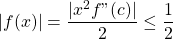
so when we apply
For problem 3, can we use the Taylor’s theorem instead? like for , for
, for  and for
  , the case is same because in either way

so when we apply
#1) similar sol. for question 3rd:
i.e. Maclaurin’s theorem can we used.
#2) and i think for question no. 10th: probability section i.e. in case of P[B] , there is a calculation mistake …
if not then i have doubt how { (1-p)^ 2n – k – l – 3 } comes?
because i concluded it is not -3 , it would be -4.
please correct me.
#3) for question no. 4th:
can we check limit along the curve y = x^2/3 which can also shows that f is not continuous?
#4) for |G| = pq
if we take a example of o(G) = 10 = 1*2*5
let p=2 < q=5 and both are prime.
and there is an element of order 1 (identity element) and it is non abelian group i.e. no element exist of order 10.
now phi(q) == phi(5) == (5^1-5^0) == 4
that is we can say only four elements are there of order q. And remaining elements could be of order p i.e. there are 4 elements of
order q.
Also q=5 implies that no. of elements of order q = q -1
And no. of elements of order p == o(G) – identity element – (q-1) == (p-1)q
can it be possible ?
if not give the query please.
sorry for #2)
it was my mistake.
For the 6th problem, It easily follows from the Sylow’s theorem. for some
  and
and  i.e there exist a unique subgroup of order
  . so there are
  elements of order
 has order either
  or
or  . So the remaining elements must have order

No. of q-sylow subgroup is,
and we know that every non-identity element in
Therefore the no. of elements having order q is
Sir,I am from Midnapore college ,W.B and I have decided to appear in ISI.math entrance.But I have no guide.So,I am quite confused about what type of preparation and study is needed.Please suggest me something in this regard.
I have already written everything you need to know on how to prepare for the ISI M.Math entrance exam here: https://fractionshub.com/courses/i-s-i-m-math-i-i-t-jam-exam-preparation/
Hello SIr, I am preparing for ISI MMath Entrance. Can you please provide my some training for problem solving. Is there any mock test series for ISI MMath
You will have to join the MMath group here. I teach for MMath entrance exam. No there is no mock tests for ISI MMath.
Great work…
Can you provide your what’s app group?
You can text me on WhatsApp @ 9700803692.
For problem 9, Here’s an alternative solution: then we are done. Otherwise assume that
  , also note that
  then
then  . So we have
  as dim(Ker (A) \cap ker(B)) =0 but from the given condition we have
  we have
  i.e
i.e  but from the above inequality we get a contradiction. Hence
  . Therefore the result follows
if
For problem 9, Here’s an alternative solution: then we are done. Otherwise assume that
  , also note that
  then
then  . So we have
 as
as  but from the given condition we have
  we have
  i.e
i.e  but from the above inequality we get a contradiction. Hence
  . Therefore the result follows
if
Sir ,your solution is really very helpful..
But if you provide us crash course for preparing M math ..
It will be very helpful…
For problem 2 can we use sandwich theorem instead,
Since g : [0,1] –> R, it is a continuous function from a compact set, thus its image will be compact.
|g(x)| 0
Let k be the supremum
for x belongs to [0,1)
-M(x^n) <= (x^n) g(x) <= k <= M (x^n)
applying limit and sandwich theorem, we get k tends to 0, and for x=1 since g(1)=0, thus (1^n)(g(1))=0, thus the limit always tends to zero.